Using the Angle Tools
You can use the Angle and Split Angle tools to measure the angle between any two lines, as shown below. For split angles, the angle that would exist between the line segments if they were extended far enough to intersect will be calculated.
Measured angles
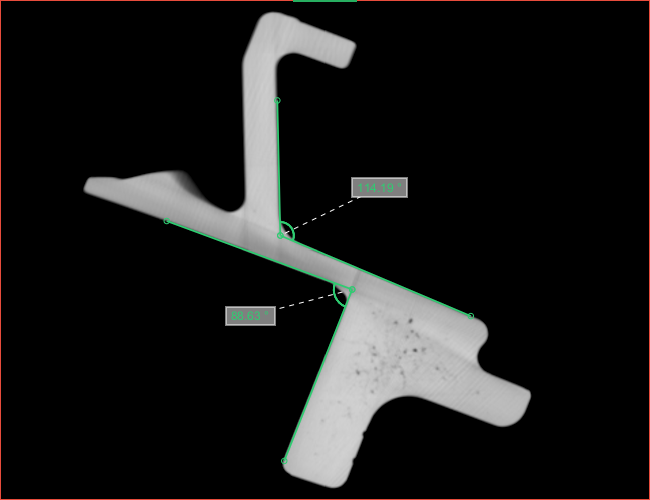
Measurements are shown with the annotation in 2D views and are also available in the lower section of the Data Properties and Settings panel.
- Maximize the required image, recommended.
- Click the Angle
 tool in the Annotate panel.
 - Click and drag to create the initial side of the angle.
- Click and drag from the vertex to create the terminal side of the angle.
The angle measurement is indicated at the vertex and in the lower section of the Data Properties and Settings panel.
- Maximize the required image, recommended.
- Click the Split Angle
 tool in the Annotate panel.
 - Click and drag to create the initial side of the angle.
- Click and drag to the level of the terminal side of the angle.
- Click and drag to create the terminal side of the angle.
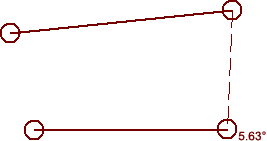
The angle measurement is indicated at the vertex and in the lower section of the Data Properties and Settings panel.
 Editing Angles
If required, you can edit an angle.
- Select the required angle, either directly in the 2D view or in the top section of the Data Properties and Settings panel.
- Click inside the control point you need to adjust and then drag.
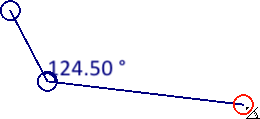
You can also select multiple control points. For example, if you need to move a side of the angle.
- Click inside the selected control point(s) to de-select it.
- Select the required angle, either directly in the 2D view or in the top section of the Data Properties and Settings panel.
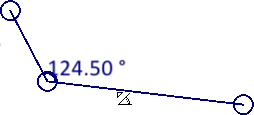
- Select any line between its control points and then drag to reposition the angle.
Angle Properties
You can customize the appearance of angles and their captions in the Properties box, shown below.
Angle properties
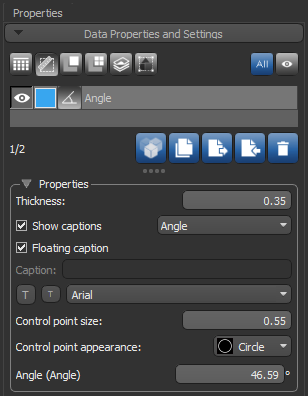
| Description | |
|---|---|
| Thickness | Indicates the thickness (in screen percentage) of the contour that defines the shape of the annotation, including its control points.
|
| Show captions | If selected, a caption will appear with the annotation. Options include:
Angle… If selected, the measured angle will be shown as the caption. Custom… If selected, the caption entered in the Caption edit box will be shown. |
| Floating caption | If selected, the caption will appear in a floating box that can be repositioned manually anywhere within the view to avoid overlapping. |
| Font size and style | Lets you increase or decrease the font size of the caption with the Increase font size and Decease font size buttons, as well as choose a font style. |
| Control point size | Lets you set the size (in screen percentage) of the annotation's control points.
|
| Control point appearance | Let you choose a shape — circle, square, triangle, cross, or 'X' — for the annotation's control points. |
| Angle | Indicates the measured angle.
|
Angle Tools
The following tools are available for angles.
| Description | ||
|---|---|---|
| Split angle |

|
Lets you convert an angle to a split angle. |
Configured Actions for the Angle Tools
A number of configured actions and keyboard shortcuts are available for creating and editing angles. The default settings for these actions are listed in the following table.
| Action | Key | Mouse |
|---|---|---|
| Create an angle in Angle mode | Left mouse | |
| Edit an angle in Angle mode | Left mouse | |
| Create a split angle in Split Angle mode | Left mouse | |
| Edit a split angle in Split Angle mode | Left mouse | |
| Switch to Angle mode | A | |
| Switch to Split Angle mode | Left Ctrl + A |